AI for Nonprofits: Automate the Manual Work, Not the Stewardship
Responsible nonprofit AI isn't about replacing people. It's about reducing manual work so your team can focus on stewardship and mission.
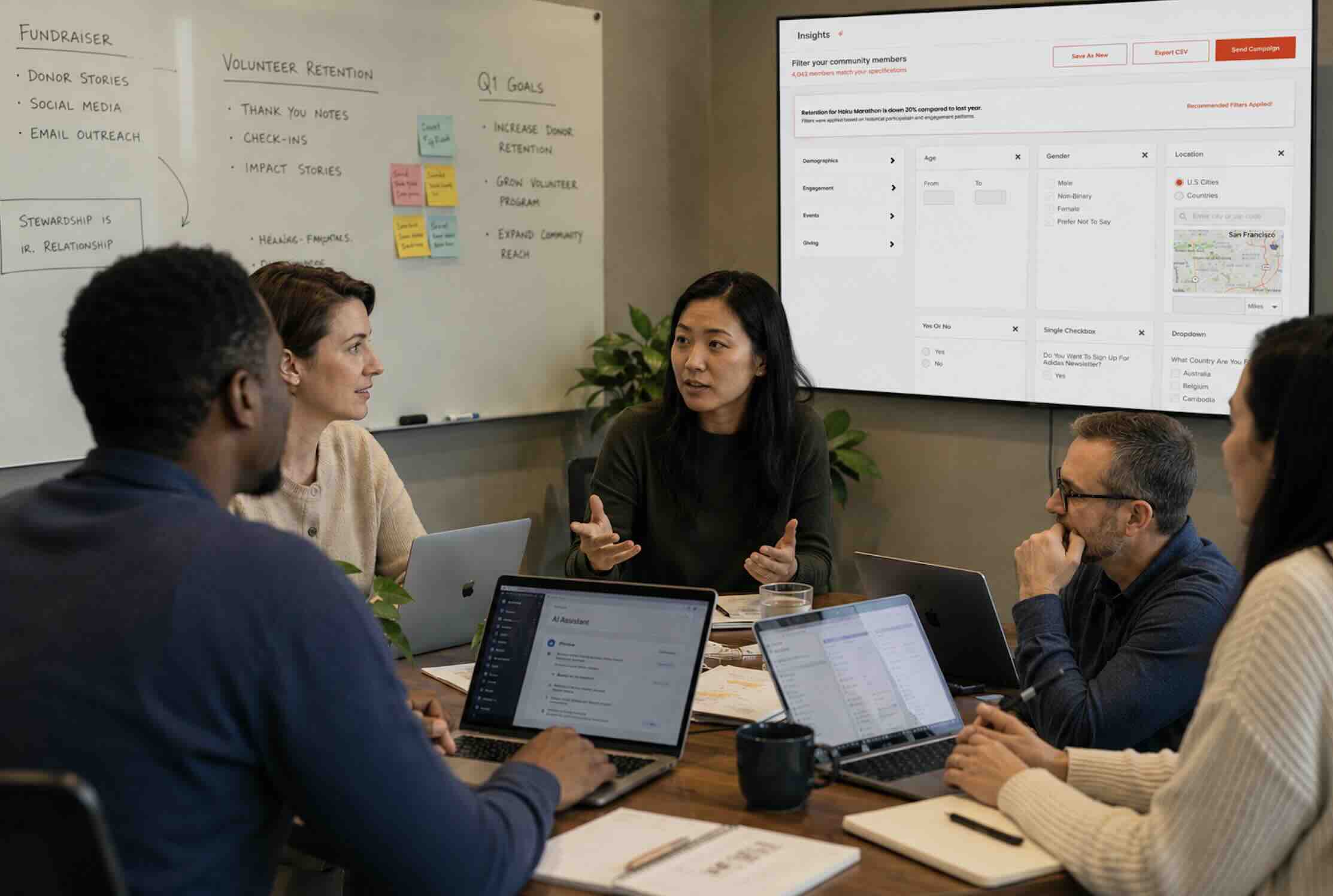
Most nonprofit AI advice starts with the promise that a smaller team can suddenly do more with less if they just automate everything.
When that pitch lands, it’s because nonprofit teams are already being asked to do more than their systems, staffing, and calendars can reasonably support. Fundraisers are carrying too many relationships while operations teams are reconciling too many reports, and event teams are expected to deliver better participant experiences with limited staff, limited time, and very little room for error.
As you know, nonprofit work does not happen in a demo environment. Instead, it happens when a fundraising lead is trying to understand a donor’s history before a call, when an event staff member is responding to a frustrated participant without the full context, or when an operations lead is building a board report. The places nonprofits can benefit most from AI are these repetitive processes.
But any AI adoption needs to be treated with due caution as well. “How much can we automate?” treats efficiency as if it is your end goal and assumes the work most worth removing is whatever a machine can imitate.
Nonprofits need to be clear about what AI’s role is for their organization. AI should remove the administrative burdens that drain staff time and keep people away from the human work that actually sustains the mission.
Automations earn their place when they help staff find information faster, summarize scattered context, identify missing data, categorize requests, and reduce the operational issues that make meaningful work harder. The real enemy you’re fighting are duplicate entries, disconnected systems, stale exports, missing fields, reports rebuilt by hand, and supporter histories scattered across inboxes and spreadsheets. Your nonprofit team is still the hero that makes human outcomes possible. Automation only matters when it gives your team enough context and capacity to show up for people and your mission.
Manual, Repetitive Work Is the Place to add Automation
The best nonprofit AI use cases are rarely glamorous, and that’s a good thing. Their value comes from removing the work that keeps fundraisers, event directors, service teams, and operations leads away from donors, participants, volunteers, sponsors, and mission-critical decisions. You want to automate the things no one wants to do, not the critical relationships your organization needs to curate.
Start with the work no one builds a conference presentation around: cleaning records, summarizing notes, drafting internal recaps, routing requests, searching old communications, finding missing fields, tagging common support issues, creating task reminders, reconciling campaign performance, and turning registration, fundraising, donation, merchandise, and service data into something a human can actually use.
You end up losing capacity and bandwidth (and increase the likelihood of staff burnout) through a thousand small friction points that end up with everything from fundraiser communications to campaign recaps becoming archaeology projects as your team digs through unclear data by hand.
Automation should clear the administrative burden around donor relationships, mission voice, and sensitive decisions rather than claim ownership of the relationships, voice, or decisions themselves. In a nonprofit event workflow, useful AI tasks won’t involve writing the stewardship strategy or white-glove emails to your most important supporters. Instead expect AI to prepare a first-pass event recap from registration and donation activity, or surfacing recurring service questions before they become a larger participant experience problem.
At haku, we know automation only has value when it reduces manual work across event, fundraising, and supporter workflows without taking control away from the people responsible for those relationships. When teams can see more of the supporter relationship in one place, automation becomes more useful because it works from a better context. More importantly, people become more effective because they are not spending their best attention rebuilding the same picture over and over.
AI Should Prepare the Person, Not Pretend to Be the Person
Automation can prepare a person for stewardship, but it should not impersonate the person doing it. That boundary matters most in the moments where the work depends on memory, timing, relationship history, and judgment rather than cleanly formatted language.
AI can summarize, draft, classify, and identify patterns. It can even process records sometimes, but it cannot be a trusted human touchpoint.
Consider that AI does not know why a donor gave, what happened in the conversation after last year’s event, or why a participant keeps returning to a cause even when life makes participation difficult. Nor does it understand which sponsor relationship is politically complicated, which volunteer has been quietly holding a program together, or which long-time supporter needs a phone call instead of another polished email. Only a human can do that.
Stewardship means making decisions based on your own judgment over time, not merely communication. An event staff member responding to a frustrated participant is not simply resolving a ticket. They are protecting the experience, interpreting policy, and deciding when the answer should be efficient and when it should be personal.
In practice, automation might summarize a supporter’s event participation, fundraising activity, donation history, and service interactions before a staff member reaches out. It might draft several possible follow-up notes so the fundraiser does not start from a blank page. A repeated support issue might also get flagged before a staff member responds, changing the tone and urgency of the reply. In all of those cases, automation gives the human being a better starting point.
A person still needs to decide what any particular piece of information means and whether the next step should be an email, a call, a thank-you, an apology, an escalation, or no ask at all. The relationship belongs to your organization and the people you serve, not to the tool that helped organize the context.
Nonprofit Skepticism Around AI Adoption Makes Sense
Nonprofit leaders do not need to be talked out of caution. They have seen technology promises arrive with clean decks, vague benchmarks, and little understanding of how mission-driven work actually happens. Systems that were supposed to save time have created new administrative burdens. Data projects have stalled because the source records were incomplete, duplicated, or scattered across disconnected tools. Too many teams have been told to “scale relationships” by people who seem oddly uninterested in the relationships.
When nonprofit teams raise concerns about AI, they are not being old-fashioned. They are recognizing a very real reputational risk.
Nonprofit leaders and staff are acutely aware of the slow erosion of trust that comes from small acts of careless automation. When a donor gets a message that should sound personal but clearly is not or a fundraising captain receives a response that misses the context of their issue, this signals that your organization doesn't care about your community, even if you very much do.
One mistake may not ruin a relationship. But enough of them teach people that the organization is optimizing the appearance of care rather than practicing it.
That’s why AI governance cannot sit off to the side as a legal footnote or an IT concern. It belongs inside the stewardship conversation, where nonprofit teams decide what kind of organization they are willing to become in pursuit of efficiency.
A blanket yes or no around AI and automation will not help a nonprofit team make the best choice possible. Teams need to know where AI can safely support the work, where human review is required, and where the final decision must stay firmly with a person.
For haku, responsible automation has to show up in the product and the service model. That’s why haku takes provisioning, permissions, implementation support, workflow design, and client guidance very seriously. All of that helps teams like yours understand what they should automate before they automate it. Any efficiency gains are only useful if it protects the trust your organization has spent years earning.
Use a Risk Ladder, Not a Blanket Policy
A lot of AI policy work gets stuck because teams try to treat every use case the same. Writing an internal summary is not the same as sending a donor appeal. Flagging duplicate records is not the same as deciding who receives high-touch stewardship. Drafting a campaign outline is not the same as making claims about program impact.
Nonprofits need a risk ladder that matches the level of human review to the stakes of the workflow. The more a workflow affects trust, privacy, money, service, dignity, or public claims, the more human control it needs.
Another thing to note is that not every AI-assisted task needs a lengthy approval process. Meaningful review is an absolute necessity wherever a mistake could damage trust, expose private information, misrepresent impact, mishandle money, or treat someone without the dignity the mission requires.
That said, review is not a decorative step added after the real work. In high-stakes nonprofit workflows, review is part of the work. You can use the risk ladder concept to identify where you need to spend more time reviewing, and where you can reduce cycles.
AI Is Not a Shortcut Around Bad Systems
AI will not rescue you if you have messy systems, because AI is only as good as the inputs. In other words, incomplete supporter data produces incomplete context. And it should come as no surprise that staff who do not trust the data today will not magically trust an AI-generated output tomorrow. They may trust it less, and in many cases they should.
Automation only deserves trust when the systems underneath it give staff enough context to trust the output. Teams need visibility across events, fundraising, donations, purchases, campaigns, and service interactions. They need to understand what changed, who acted, and what needs follow-up. Segmentation should reflect meaningful behavior rather than whatever fields were easiest to export. Leaders also need to know whether automation improved the work or simply made the workflow look more modern.
Automating the Work Around Care With Care
Nonprofits should be wary of any AI pitch that treats humanity and care as inefficiency.
Stewardship takes time, as does good service and human review. Anyone who thinks those are defects in the nonprofit model, is in the wrong line of work. So don’t automate care. Instead, automate the work around care: the searching, summarizing, tagging, routing, cleaning, drafting, and reporting that make it harder for staff to show up well.
AI deserves a place in the workflow because when you use it right, AI can give people more time, context, or clarity for the work only people can do.
If you want to use AI in your nonprofit, you need to remember that the nonprofits that use AI best will not be the ones chasing the most visible automation. Instead, they will draw careful boundaries around real workflows, connected data, and human review, treating automation as a way to create capacity rather than dilute responsibility.
So AI can help a nonprofit prepare, prioritize, and follow through, but supporter relationships still belong to people. That’s the way it should be.
Are you ready to automate the manual, repetitive tasks reducing your organization's capacity? Talk with haku about reducing manual work across your event, fundraising, and supporter workflows while keeping your team in control.