From Communities to Customers: The Power of Run Clubs
Run clubs have evolved. What once was a fairly obscure, often grassroots, part of the running community has become one of the most powerful drivers of growth for endurance events.

Run clubs have evolved. What once was a fairly obscure, often grassroots, part of the running community has become one of the most powerful drivers of growth for endurance events.
Today, run clubs sit at the intersection of community, accountability, and influence. They’re where runners build relationships, stay motivated, and ultimately decide which races to run together. That shift has changed their role from peripheral to being a foundational part of how your participants experience running.
Run clubs are exploding in popularity. Strava recently reported a 59% increase in run clubs, while surveys show that roughly 85% of runners have participated in one. At the same time, community runs are getting noticeably larger, with groups of 200+ runners becoming increasingly common in major cities.
When you look at it in that context, the scale is pretty impressive. A lot of events are now managing anywhere from 100 to 1,000 run club participants per race and in many cases, even more than that. Some individual clubs alone are pulling in 300 to 400 members. We’re seeing customers like the LA Marathon and New York Road Runners lean into haku’s run clubs feature.
It’s the group dynamics that emerge from run clubs that make them so valuable for endurance event organizers. Run clubs create built-in networks of trust. They drive repeat participation because members hold each other accountable. For event organizers, that trust turns run clubs into organic marketing engines, spreading awareness through word of mouth in a way traditional campaigns simply can’t replicate.
It sounds almost too good to be true. An already trending activity, joining a run club, has a direct, positive impact on event revenue. But as impactful as run clubs are, there’s a growing tension beneath the surface. Because while they drive meaningful growth, they also introduce a level of complexity that most endurance event teams aren’t equipped to manage.
The Challenges of Scaling Run Club Programs
If you’ve ever tried to scale a run club program, you’ve likely felt this firsthand. What starts as a great idea, partnering with local clubs, offering group perks, building community, quickly turns into an operational headache.
Most teams are still relying on fragmented workflows to manage something that has outgrown them.
Roster tracking, for example, often becomes a manual process. Teams export participant lists, filter by team names or codes, and merge spreadsheets just to figure out who belongs to which club. It’s tedious, time-consuming, and prone to errors.
At the same time, the structure of partnerships adds another layer of difficulty. Different clubs may have different discounts, unique codes, or custom agreements. Keeping track of who gets what can quickly spiral into confusion.
And then there’s the challenge of scale. As you add more clubs, each with their own leaders, incentives, and timelines, managing those relationships becomes increasingly difficult. Without a centralized system, everything lives in inboxes, spreadsheets, and scattered notes.
Perhaps the most frustrating part is the lack of visibility. Even after doing all the manual work, many teams still struggle to answer basic questions: Which clubs are actually driving registrations? Which partnerships are worth investing in? Where should we focus next?
Instead, they’re stuck piecing together insights after the fact.
It creates a frustrating reality: run clubs are one of your strongest growth levers, but managing them is just another piece of chaos in your too-busy schedule.
The Missing Piece
What if managing run clubs felt as organized and scalable as the impact they deliver?
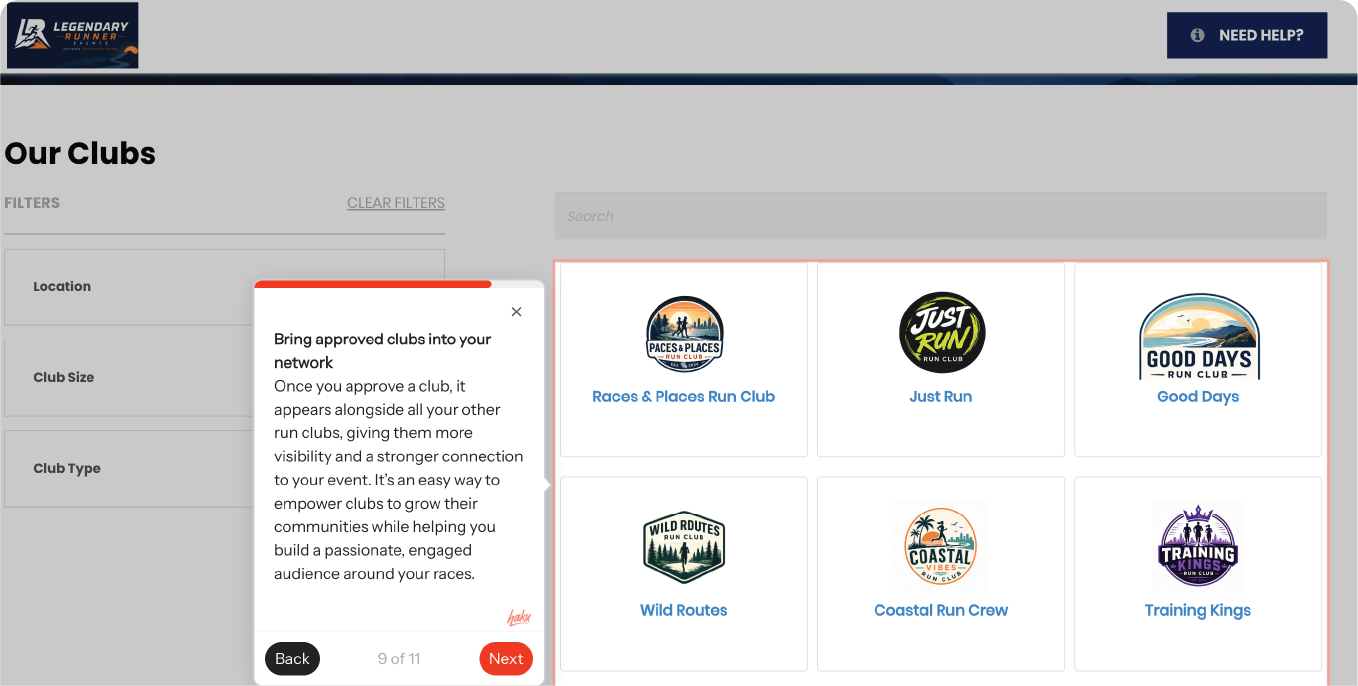
That’s exactly what haku’s run clubs solution makes possible. haku brings everything into one place including clubs, members, leaders, incentives, and performance, so you’re no longer stitching together information across multiple tools.
Instead of manually tracking rosters, participation updates automatically in real time. Instead of juggling discount codes and agreements, you can structure and manage incentives directly within the system. And instead of guessing which partnerships are working, you gain clear visibility into performance. Run clubs stop being something you manage reactively and start becoming something you grow intentionally.
See how with a quick, self-guided product tour: 👉 Take the tour

Activating Registrations Through Run Club Partnerships
The most successful events are using run clubs strategically rather than hoping for the best.
Rather than treating run clubs as passive audiences, leading events actively build partnerships with them. What makes this approach so effective is the way run clubs operate. People don’t sign up in isolation. They sign up because their group is signing up. They train together, talk about the race together, and hold each other accountable.
That dynamic leads to higher conversion rates and larger group registrations, turning each club into a multiplier rather than a single registration.
Driving Early Registration and Momentum
Run clubs are also incredibly effective at influencing when people register, not just if they register. By tying incentives to milestones such as early deadlines or participation thresholds, events can create urgency within each club. Perks like early access or improved corral placement give groups a reason to commit sooner.
What’s interesting is how this plays out socially. Once a few members register, momentum builds quickly. Leaders encourage participation, members remind each other, and the group collectively pushes toward the goal.
Instead of chasing last-minute registrations, you create a natural pull toward early commitment.
Building Real Community, Not Just Campaigns
There’s also a deeper shift happening in how events engage with run clubs.
The most effective teams aren’t just promoting to clubs, they’re partnering with them. That means treating clubs as collaborators, not just channels. It means communicating directly with leaders, understanding their communities, and engaging in a way that feels authentic rather than transactional.
This matters more than ever, especially with younger runners. For many, run clubs aren’t just about training, they’re social hubs. They’re where friendships form, identities take shape, and decisions are influenced.
When you show up as a partner within that ecosystem, you’re not just driving registrations. You’re building lasting relationships.
Using Data to Get Smarter Over Time
One of the biggest missed opportunities in run club programs is the lack of structured insight. When participation is properly tracked through unique identifiers or a unified system, you can start to see patterns clearly. You can identify which clubs are most active, which partnerships deliver the highest return, and where your efforts are having the greatest impact.
Instead of treating every club the same, you can prioritize the ones driving results, re-engage those that are underperforming, and continuously refine your strategy.
What This Looks Like in Practice
This shift from manual management to strategic growth is already playing out across events of all sizes. Large-scale races, like the LA Marathon and the TCS New York City MarathoN, often manage hundreds of participants across numerous clubs. Historically, coordinating incentives like corral placement and tracking participation required significant manual effort, often leading to roadblocks. With a centralized system, those same processes become simplified and automated, allowing teams to focus less on logistics and more on growth.
Other organizations have leaned into a community-first approach. Rather than viewing run clubs purely as a registration channel, they focus on building genuine relationships. By positioning their events as partners to these communities, they’ve created stronger engagement and long-term loyalty.
There’s also growing success in more targeted approaches. Some events are identifying niche clubs, such as women’s power walking groups or beginner-focused communities, and tailoring their outreach accordingly.
The takeaway is clear: run clubs are not one-size-fits-all. The more intentional your approach, the more effective your results.
The Impact of Getting It Right
When run clubs are managed and activated effectively, the results compound quickly.
Events often see a meaningful share of registrations driven directly by club participation. Early registration rates improve as group dynamics create urgency. And internally, teams spend far less time on manual administrative work. Instead of reacting to complexity, teams operate with clarity. All this is possible when you embrace run clubs as a core growth engine.
It creates a domino effect: more clubs lead to more participants, which strengthens community, which in turn drives even more growth.
Run clubs aren’t going anywhere. If anything, their influence is only growing.
They represent something deeper than participation, they represent connection. And in today’s landscape, that’s one of the most powerful drivers of engagement you can have.
Ready to learn more & see how you can manage run clubs in haku? Take the self-guided tour here