Gen Z Fundraisers Need Structure, Not Stereotypes
When it comes to peer-to-peer fundraising, Gen Z underperforms, but why is that? In this blog, we break it down and share how to enable any fundraiser to succeed.
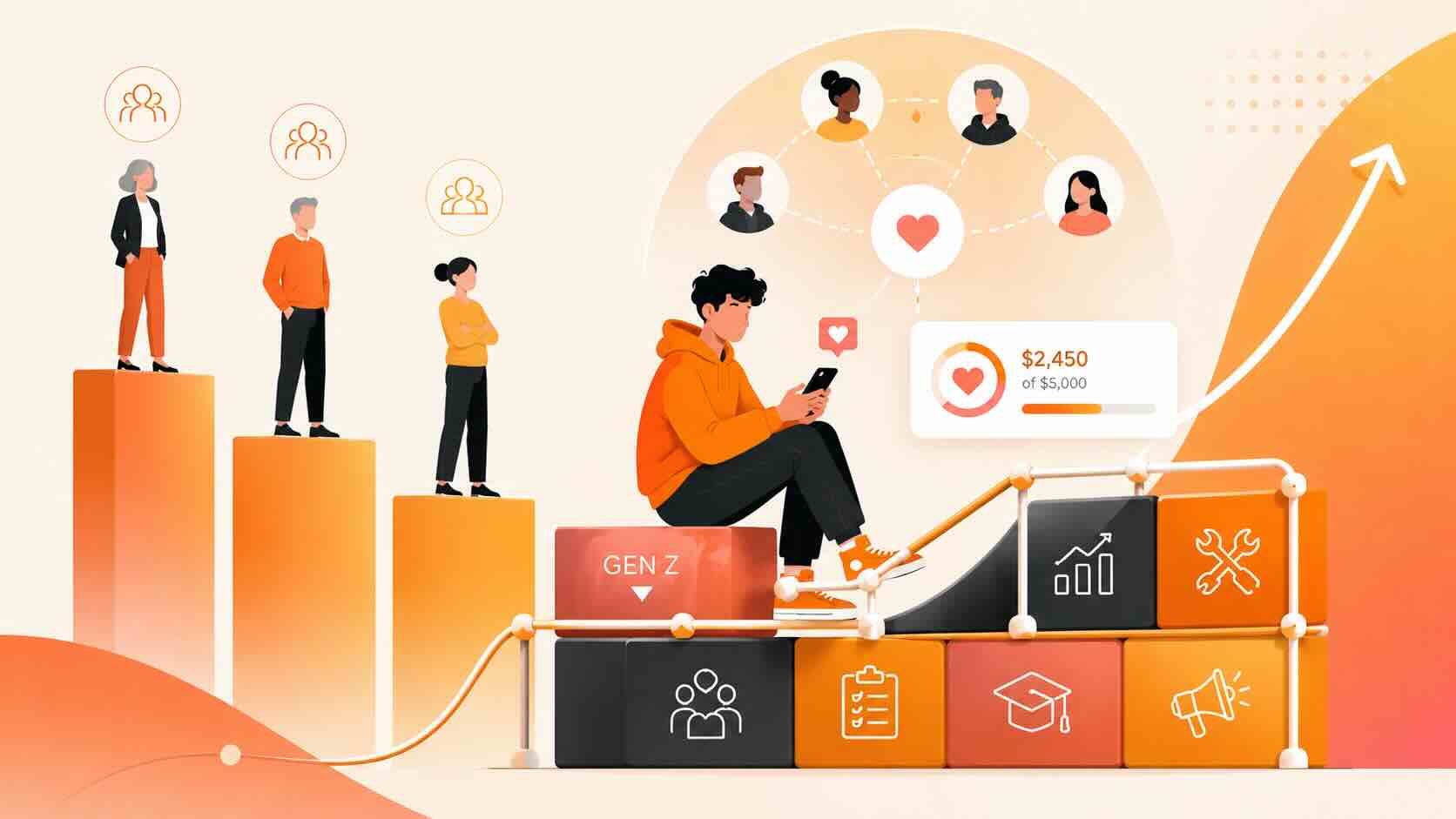
Gen Z fundraisers trail older cohorts in minimum attainment, but nonprofits should be careful about what they do with that information.
The easy interpretation is also the weakest one: younger fundraisers are less committed, less capable, or less willing to ask for support. That reading turns a data point into a stereotype. It also gives nonprofit teams very little to work with.
A more useful interpretation is that younger fundraisers often have less accumulated fundraising infrastructure around them. They may have less experience making direct asks, smaller donor networks, fewer repeat fundraising habits, and less connection to the team structures that help fundraisers follow through.
That is not a reason to recruit around younger fundraisers. It is a reason to support them better.
The data shows a Gen Z fundraising gap
In haku’s report, The Data Behind Fundraising Success, Gen Z fundraisers had the lowest minimum attainment rate of any age cohort, with 55.5% meeting their fundraising minimum.
Minimum attainment increased with each older cohort: 69.4% for Millennials, 74.9% for Gen X, 80.3% for Baby Boomers, and 87.9% for the Silent Generation.
On its face, the pattern is clear. Fundraisers in older cohorts are more likely to meet their minimums than Gen Z fundraisers. But the ranking itself is not the most useful part of the finding.
But before you give up on the younger generations and scoff “Okay, Zoomer” to prospective fundraisers, you should stop and think, “why does the performance gap actually exist?”.
If nonprofits stop at the surface-level conclusion, they risk making the wrong strategic moves, and that’s doubly true here. The answer is not to assume younger fundraisers are a weaker audience for fundraiser recruitment. You need to understand what conditions help fundraisers succeed, then build more of those conditions into the Gen Z fundraiser experience so that they meet their minimums the first time, and return for years to come.
The better question is why the gap exists
In our data driven report, we looked at age, because the fundraiser’s age is visible in the data, but it may not be the real driver behind Gen Z’s lower performance.
The report itself cautions against treating age as an inherent performance trait. Older fundraisers may perform better because they have had more time to build donor relationships, participate in fundraising campaigns, develop confidence, and learn what kinds of messages move their networks to give. In other words, age may be standing in for accumulated opportunity.
If a nonprofit reads the data as “older fundraisers are better,” the likely response is narrower recruitment. That may look efficient, but it weakens the long-term pipeline, which matters because the only way to move from a first time fundraiser to an experienced one is to start fundraising in the first place.
What the data is really saying is that “fundraisers with more experience, connection, and support tend to perform better.”
That’s actionable. Your response becomes smarter program design rather than excluding a generation of potential fundraisers. That approach does not lower expectations for Gen Z, but instead gives them the structure that more experienced fundraisers may already have.
The broader haku dataset supports that second interpretation. Experience is one of the clearest predictors of fundraising success. First-time fundraisers meet their minimums 52.7% of the time, while fundraisers with at least two prior fundraising cycles reach 83.9% minimum attainment.
That is the long game. Nonprofits do not just need younger fundraisers to perform once. They need those fundraisers to have a good enough experience to return, build confidence, and become stronger over time.
Team connection may be part of the missing structure
Across all fundraisers in the haku dataset, team members meet their minimums 80.2% of the time, compared with 63.0% for non-team fundraisers. Team members also show stronger over-goal performance and stronger partial progress even when they do not meet their minimums.
As Jackie Levi, haku’s Chief Strategy Officer, shared in her webinar going over the report data, Gen Z fundraisers were also the least likely cohort to be on teams. Only 27.4% of Gen Z fundraisers were team members. Team membership rose with each older cohort: 35.8% for Millennials, 42.3% for Gen X, 43.7% for Baby Boomers, and 45.6% for the Silent Generation.
In other words, the youngest fundraisers have the lowest minimum attainment rate and the lowest team membership rate. Meanwhile, team membership is one of the strongest indicators of better fundraising performance overall.
So the real issue isn’t that Gen Z fundraisers simply lack motivation. What this shows is that Gen Z fundraisers are less often placed inside one of the support structures most associated with fundraising follow-through.
That makes Gen Z fundraising performance a pipeline issue, not just a current-year revenue issue. A weak first campaign does not only affect this year’s totals. It can shape whether a fundraiser comes back, joins a team, develops confidence, and eventually becomes one of the experienced participants who drive stronger results in future campaigns.
So what does all of this mean for you?
Four ways nonprofits can better support Gen Z fundraisers
The best response to this data is not to stereotype younger fundraisers or lower expectations. It is to design a better first fundraising experience.
Put younger fundraisers into teams by default
If teams are one of the strongest signals of fundraising success, team formation should not be treated as an optional feature buried inside registration.
Nonprofits can create open teams for fundraisers who do not arrive with a group, pair newer fundraisers with experienced captains, and build cohorts around campuses, workplaces, run clubs, young professional groups, or shared event goals.
The point is not to force a social experience. The point is to make sure newer fundraisers are not expected to build confidence, accountability, and momentum alone.
Give fundraisers the ask before asking them to fundraise
A fundraising page is not the same thing as a fundraising plan.
Younger or newer fundraisers may care deeply about the mission but still feel uncertain about how to ask. Nonprofits can remove that friction with ready-to-use text messages, email templates, social captions, first-week launch prompts, and follow-up language for people who do not respond right away.
The best templates should not sound canned. They should give fundraisers a starting point they can personalize, especially for close friends, family, coworkers, classmates, and community contacts.
Motivation matters, but motivation is not a message strategy. Fundraisers need language they can use when the ask feels awkward.
Build momentum with smaller early milestones
A full fundraising minimum can feel abstract at the beginning of a campaign. Smaller milestones help fundraisers get moving.
Instead of waiting until someone falls behind, nonprofits can coach toward early wins: the first donation, the first three asks, the first $100, the halfway mark, or the first team contribution. These smaller moments create confidence and give fundraisers a reason to keep communicating.
They also give staff better signals. A fundraiser who has not made a first ask in the opening week needs a different nudge than someone who is halfway to goal but slowing down.
Early momentum does not guarantee final success, but it gives fundraisers something to build from. For newer participants, that first sign of progress can change the entire emotional shape of the campaign.
Use experienced fundraisers as mentors, not just examples
Experienced fundraisers are often treated as proof that success is possible. They can be more valuable than that.
Nonprofits can invite returning fundraisers to captain mixed-experience teams, host short office hours, share actual messages they used, or mentor first-time participants through the first few weeks of the campaign. This turns experience into a transferable asset.
That matters because haku’s data shows experience is one of the strongest predictors of performance. The goal is not simply to celebrate experienced fundraisers. It is to help newer fundraisers become them.
Support structure is the strategy
Gen Z fundraisers do not need lower expectations. They need better scaffolding to achieve what more experienced fundraisers already know.
The broader message of haku’s fundraising data is that success comes from connection, experience, and support. Younger fundraisers may have less of that infrastructure when they enter a campaign, but nonprofits can change the conditions around them.
That is the opportunity. Do not turn Gen Z’s performance gap into a stereotype. Turn it into a better first fundraising experience.
Read the full haku report, The Data Behind Fundraising Success: From Seven Years of Real Demographic and Behavioral Data.